
Amen
Line Art Alters by ReNude Art Studio •This is a non-commercial, transformative work of fan-art created for body-neutrality advocacy. It is entirely independent and not affiliated with, or endorsed by, the original creators or syndicates.
Amen
Line Art Alters by ReNude Art Studio •This is a non-commercial, transformative work of fan-art created for body-neutrality advocacy. It is entirely independent and not affiliated with, or endorsed by, the original creators or syndicates.

Earl
Line Art Alters by ReNude Art Studio •This is a non-commercial, transformative work of fan-art created for body-neutrality advocacy. It is entirely independent and not affiliated with, or endorsed by, the original creators or syndicates.
Welcome to ReNude Art Studio, a unique creative space where classic American draftsmanship meets a pure, uncomplicated view of the human form.
ReNude Art Studio is a collection of transformative fan-art that goes far beyond simply removing clothing. It is about using existing art as a foundation to discover an entirely new message. Through careful, dedicated digital alteration, these pieces dismantle the artificial barriers of conventional attire in everyday spaces.
If clothing is unnecessary for protection at beaches, homes, backyards, and natural swimming spots, why draw it? There are so many places where we’ve been conditioned to think that clothing is necessary, when it simply… isn’t.
By recontextualizing these familiar scenes, we strip away centuries of arbitrary social codes and fashion anxieties. The result isn’t just a visual shift, but a narrative transformation that grounds these everyday settings in authenticity, pure comfort, and a closer connection to our environment. Stripped of pretense, the human body is normalized exactly as it is: a natural form existing gracefully in everyday life.
They’re also funny.

This project is born out of a deep respect for the medium of newspaper comics. The goal is never parody or satire. We love these artists’ work and add our own wholesome, creative tribute to their beautiful linework and storytelling. Our modifications demonstrate that life works beautifully—and often with a greater sense of authentic connection—exactly as we came into the world.
Because we deeply respect the intellectual property and legacy of working cartoonists, ReNude Art Studio operates under strict principles of transparency:

Join us as we journey into the past and present with an unadorned look at modern life, ReNude style.
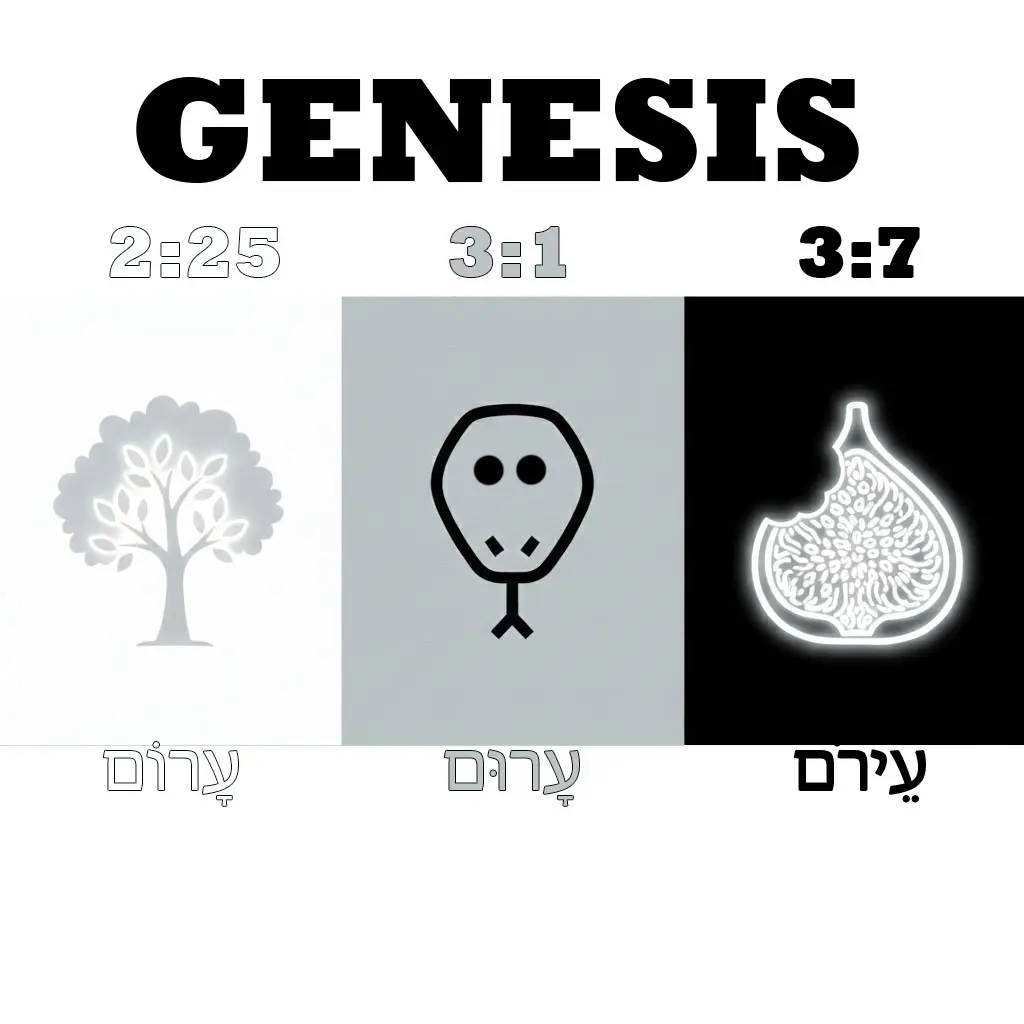
In our modern English Bibles, “naked” is just a flat, singular word. It conjures a specific image—usually one of vulnerability or perhaps something that needs to be covered up. But in the original Hebrew, the concept isn’t flat at all. It has depth. It has intensity. There are three shades of nakedness in Genesis 1-3.
Think of it like a grayscale. We often talk about white, gray, and black as “colors,” but they aren’t. They are shades. They represent the intensity of light or the lack thereof. In the Garden of Eden, we see the word “naked” shift through three distinct shades, and if we don’t pay attention to the Hebrew vowels, we miss the entire story of the human soul.
The story begins in the light.
“And the man and his wife were both arowm, (naked without lack) and they were not ashamed.”
Genesis 2:25
This is the White of the grayscale. It is the shade of innocence, but more than that, it is the shade of wholeness. To be arowm is to be existing exactly as you were created—unburdened, complete, and lacking nothing. In this state, there is no need for a “protector” because there is no threat. There is no need for “provision” because everything is provided. White is the presence of all light; arowm is the presence of all God’s intent.
But then, the intensity shifts. Just a few breaths later, we meet the serpent.
“Now the serpent was more aruwm (naked shrewd) than any beast of the field…”
Genesis 3:1
Here is our Gray. Most translators cunningly stop using the word “naked” here and switch to “shrewd,” “prudent,” or “crafty.” But in the Hebrew mind, this is just a different shade of the same root.
Think of gray matter—the brain. This is the nakedness of the mind, a kind of strategic wisdom. It isn’t necessarily “evil” (Proverbs uses this same word to describe the prudent man), but it is a departure from the pure white of simple being. It is the sharp, calculating edge of intelligence. The Serpent wasn’t just “naked” like the humans; he was “nakedly strategic.” He was the gray area between innocence and the dark.
Finally, the light is blocked out. After the fruit is eaten, the humans look at themselves and a new word enters the vocabulary:
“Then the eyes of both of them were opened, and they knew that they were eyrom (naked lack)…”
Genesis 3:7
This is the Black of the scale. This isn’t the “shame-less” nakedness of the beginning. Eyrom is the shade of lack. It is the feeling of being stripped, exposed, and unprotected. It is the heavy realization that you are no longer “whole.”
When Adam hides in the trees and tells God, “I was afraid because I was eyrom,” he is declaring his own bankruptcy. He is saying, “I am in the dark. I have nothing left.”
One of the most profound moments in this linguistic journey happens when God responds to Adam’s fear. God doesn’t say, “Oh, I see you’ve lost your clothes.” He asks a piercing question:
“Who told you that you were eyrom (lacking)?”
God is effectively saying: “I never called you that. I spoke a different shade over you. I called you arowm—whole, complete, and radiant. Where did you get the idea that you were unprotected? That proclamation did not come from Me.”
Even in their rebellion, God still saw them through the lens of His original intent. He saw the White, while they could only see the Black.
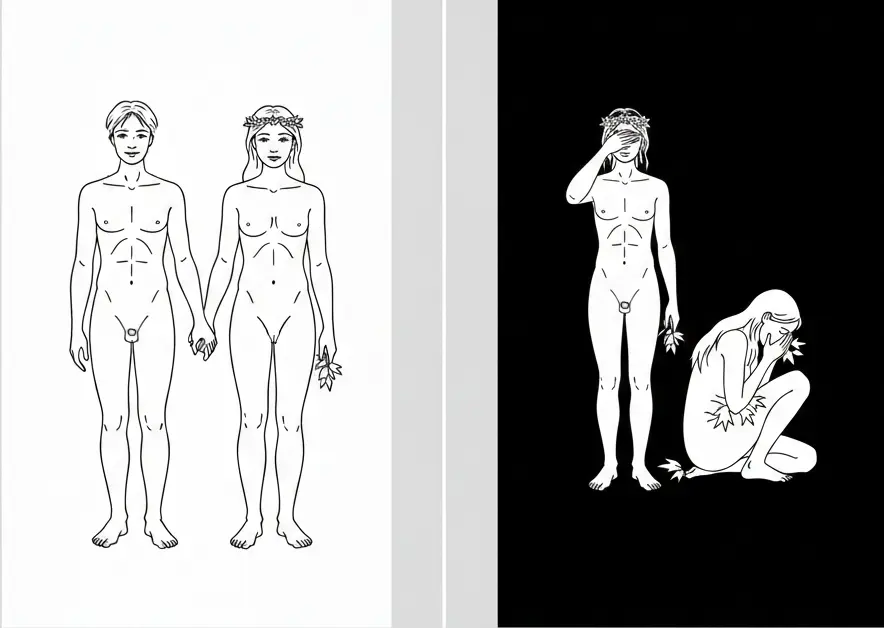
We, modern readers, tend to think of the Fall as a change in our physical bodies, but these Hebrew “shades” suggest it was a change in our perception. We moved from the bright wholeness of arowm into the gray calculations of aruwm, and finally plummeted into the black fear of eyrom.
When we understand that “naked” isn’t always “naked,” we start to see the invitation of the Creator. He isn’t looking for us to “cover up” our lack; He’s provided for us a way to come back into the light where we don’t need the strategy of the serpent or the fear of the fallen. He is calling us back to the White—to be arowm once again, lacking nothing in His presence.
Humanity’s power grab in the Garden broke the seamless fellowship they enjoyed with the Creator. By choosing their own way, they separated themselves from the Source of Light. Consequently, though God never spoke eyrom (lack) over them, that was all humanity could see. They became trapped in the “Black” shade—blind to their original wholeness and fixated on their own vulnerability.
But the story doesn’t leave us in the dark.
To fix a broken perception, we needed a new Prototype. We needed someone to step back into the grayscale and restore the Light.
“Thus it is written, ‘The first man, Adam, became a living being’; the last Adam became a life-giving spirit. But it is not the spiritual that is first but the physical and then the spiritual. The first man was from the earth, a man of dust; the second man is from heaven. As was the man of dust, so also are those who are of the dust, and as is the man of heaven, so also are those who are of heaven. Just as we have borne the image of the man of dust, we will also bear the image of the man of heaven.”
1 Corinthians 15:45-49 (NRSVUE)
Jesus, the Last Adam, didn’t just come to “cover” our lack; He came to kill the version of us that believed in lack. Through our union with Him, we undergo a total structural shift.
This isn’t a promise for a distant future or a reward in the afterlife. Our restoration to the “White” shade of arowm happens the moment we are joined to the Last Adam.
“What then are we to say? Should we continue in sin in order that grace may abound? By no means! How can we who died to sin go on living in it? Do you not know that all of us who have been baptized into Christ Jesus were baptized into his death? Therefore we have been buried with him by baptism into death, so that, just as Christ was raised from the dead by the glory of the Father, so we too might walk in newness of life. For if we have been united with him in a death like his, we will certainly be united with him in a resurrection like his.”
Romans 6:1-5 (NRSVUE)
Through this death and resurrection, the lens is wiped clean. We no longer have to view ourselves through the “Black” of eyrom—the state of being ashamed, unprotected, or “not enough.”
Friend, are you in Christ? If yes, look at yourself! We can see ourselves and the rest of humanity through the lens of arowm right now, on this earth. We are whole. We are provided for. We are innocent. The “shading” of our lives has been reset by the Man from Heaven. We are arowm in Christ today.
This is Good News! Maybe you should share it with someone?

Earlier this year we released Between Sand and Salvation, a story that carried Ashley Harper through the deserted island of her past and into a new season of healing and purpose.
That book has already sparked so many conversations about grace and restoration! The unexpected ways God reaches into our lives, especially when we least expect it, has really resonated with readers. And truly, your messages and reflections have meant the world!
Now it is time to return to the Boundless Chronicles with Book 3: Between Sight and Soul, the long-awaited dive into Evan James and the quiet battles he has carried for years. For new readers, Evan was the “boy next door” who played a pivotal, if controversial, role in Becs’ story in Between Sun and Skin.
Curious readers have asked again and again for more of Evan’s story, and this book finally opens that door!
Evan’s journey is different from Ashley’s, but just as honest.
His struggle is not so much about body shame, but about the weight of expectation and the unseen pressures that shaped him long before he met Becs.
This book explores what happens when a man finally stops living by what everyone else sees and begins listening to what God is speaking to his soul.
Jason Stern
Expect moments of raw honesty, beauty in unexpected places, and scenes where the simplicity of bare humanity becomes a space for clarity instead of fear.
If Between Sand and Salvation was about Ashley learning to stand whole, Between Sight and Soul is about Evan learning to see himself as someone God never abandoned.
This book is personal. It is vulnerable. It is full of those quiet heart-level transformations that leave a reader thinking long after the final page. And yes, it threads deeply into the themes of grace that tie all of the Boundless Light Chronicles together.
Our goal is to have Between Sight and Soul in your hands by Christmas. Over the next few weeks I will be sharing glimpses, scene snippets, and updates as I move toward the finish line.
Thank you for walking this journey with these characters and with me. They are growing. The story is expanding. And I cannot wait to share this next chapter with you.
Stay tuned. The best parts are still unfolding.

We are thrilled to announce the newest addition to the Simple Truths series: Billy Bear’s Big Visit to Bearopolis! This charming picture book takes readers on a delightful journey to a city where clothes are king, and one little bear dares to be different.
Imagine a “clip-clop, beep-beep” city where life is governed by fashion. In Bearopolis, every single bear wears clothes—from bowler hats and button-up vests to bright, billowy dresses. Everything is tidy, proper, and, above all, covered.
But when Billy, a sweet, bare bear from the country, steps off the bus, he causes a city-wide sensation. Billy doesn’t have a hat, a vest, or a bow tie; he arrived with his own “wonderful, warm, all-weather coat” of fur. The city bears stop everything to stare.
The heart of this story lies in the contrast between Billy’s easy life and the complicated routine of the city bears.
The most important bear in the city, Bartholomew, spends his Monday grumbling at a mountain of laundry — all the socks, trousers, and shirts with tricky buttons. Meanwhile, Billy is free to splash into the city pond with a happy “YIPPEE!” because his fur is the only swimming costume he needs.
Billy’s joy and simple way of life are contagious. By the end of his visit, Bartholomew and the other city residents begin to question their own fussy routines. They realize that washing, folding, and buying clothes is a heavy burden.
Join Billy and the bears of Bearopolis as they discover that sometimes, the simple truth is that being a bare bear is simply perfect!
Billy Bear’s Big Visit to Bearopolis is available now on Amazon.com!

[Job] said, “Naked I came from my mother’s womb, and naked shall I return there; the Lord gave, and the Lord has taken away; blessed be the name of the Lord.”
Job 1:21
Did you know that in the original writings, naked didn’t just mean “naked?” There are fascinating shades of meaning to the word “naked” in Hebrew.
The nakedness we read about in the Book of Job is the very same nakedness that we see described by God in the beginning:

“And the man and his wife were both naked, and they were not ashamed.”
Genesis 2:25
The actual word here is ʻârôwm. Curiously, ârôwm is used only once in the Book of Genesis.
That can’t be right, you might be thinking.
Aren’t there are other “nakeds” in Genesis? Didn’t Adam and Eve declare to God that they were “naked?”
Indeed they did! However, what the first humans described was a different kind of nakedness: ʻêyrôm.
It’s a distinctly different version of the word, and it is used three times in Genesis Chapter 3:
“Then the eyes of both of them were opened, and they knew that they were êyrôm; and they sewed fig leaves together and made themselves waist coverings.”
“[Adam] said, ‘I heard the sound of You in the garden, and I was afraid because I was êyrôm; so I hid myself.'”
“And [God] said, ‘Who told you that you were êyrôm? Have you eaten from the tree from which I commanded you not to eat?'”
Genesis 3:7, 10, 11
And, get ready for more fun! There’s another hidden “naked” in Genesis 3, as well!
It’s in the first verse:
“Now the serpent was more ʻârûwm than any beast of the field that the LORD God had made.”
Genesis 3:1a
Why doesn’t the modern text say the serpent was “naked?” More curious, isn’t it? Yet here they are, all together.
Remember that in Hebrew, there are no vowels, so these are transliterated for us.*

ʻârôwm – nakedness as a state of being (Genesis 2:25)

ʻârûwm – nakedness as a state of strategy (Genesis 3:1)

ʻêyrôm – nakedness as a state of lack (Genesis 3:7, 10, 11)
In fact, Genesis is not the only place these unique variations are used.
While there is only once instance of ârôwm in Genesis, Job speaks to his ârôwm when he was born, as we all are. In addition to another six verses in Job, the Teacher in Ecclesiastes also writes of the simple nakedness of children.
“As he came ârôwm from his mother’s womb, so he will return as he came.”
Ecclesiastes 5:15a
First Samuel discusses ârôwm prophets, and within the prophetic books of Isaiah, Hosea and Micah, simple nakedness finds a voice.
For Isaiah, his nakedness was in response to God’s command:
“At that time the LORD spoke through Isaiah the son of Amoz, saying, “Go and loosen the sackcloth from your hips and take your sandals off your feet.” And he did so, going ârôwm and barefoot.”
Isaiah 20:2
Micah chose nakedness as his garment as he prophesied to Israel:
On account of this I will lament and wail. I will go about barefoot and ârôwm.
Micah 1:8a
Amos prophesied judgment on Israel, but said that a remnant of the people would be left with the dignity of ârôwm:
“Those who are stout of heart among the mighty shall flee away ârôwm in that day, says the Lord.”
Amos 2:16
The original audience understood the different between nakedness as a state of being and nakedness as a state of lack. It was a comfort to think of ârôwm compared to the êyrôm after the Fall. If you were êyrôm, it meant you had no benefactor, no possessions, no prospects. You were no Lord, you were just another animal.
Nakedness, in this sense, is familiar as a metaphorical (or actual) description of poverty, shame, vulnerability or lack.
This form, êyrôm, is what Adam claimed was his state after he and his wife ate from the Tree of Judgment. Many times people focus on God’s question of “Who told you that you were naked?” and wonder about the identity of the “who.”
Perhaps we should focus more on the latter part of the question. God never called Man and Woman êyrôm, so we might also look at His question as asking, “Where did you get that idea? It wasn’t from Me! I said you are ârôwm!”

Image: “The Rebuke of Adam and Eve” by Charles Joseph Natoire, created in 1740
The Creator had demonstrated His Love in making mankind naked (ârôwm) without needing anything or anyone else. All they truly needed was relationship with Him. He was their provision, their source, their benefactor, their guide, and their future!
Yet, fallen mankind chose êyrôm instead. When they ate of the fruit, they looked at themselves and saw fear and vulnerability. They no longer felt the protective presence of the Creator.
This word, êyrôm, in addition to Genesis 3, is found in Ezekiel (six instances) and once in Deuteronomy. It always means want, need, and lack:
“You will serve your enemies whom the LORD will send against you, in hunger, thirst, êyrôm, and devoid of all, and He will put an iron yoke on your neck until He has destroyed you.”
Deuteronomy 28:48
“I will hand you over to them, and they will level your mounds and tear down your elevated places. They will strip off your clothes, take your beautiful jewelry, and leave you bare and êyrôm.”
Ezekiel 16:39
In Ezekiel 18, God reminds us that He expects kindness and charity to the oppressed. If you provide bread to the hungry and a garment for the êyrôm, your deeds are are called righteous.
Do you know who else was naked in the Garden of Eden? The Serpent.
Of course he was naked, you might say. Everybody was naked!
True. But God called the serpent the most naked of all the animals God had made! At least that’s what it should say, if translators were following the same rules they used to translate ârôwm and êyrôm.

In the Hebrew, the consonants are the same for all three words. Yet, this version of naked, ârûwm, is translated as “prudent, “cunning,” “crafty,” “shrewd,” or “sensible!”
When you think of those words, you might think of a banker, or a watchmaker, or perhaps a homemaker managing her duties, but I doubt you thought of the word “naked.” Yet, that’s the original idea in Genesis. Depending on the environment, naked can mean a state of being, a state of lack, or a shrewd use of intelligence.
Here is the same word used to describe the serpent, but now it is in Proverbs:
“Every ârûwm (sensibly naked) man acts with knowledge, But a fool spreads out folly.”
Proverbs 13:16
“The wisdom of the ârûwm (prudently naked) is to understand his way, But the folly of fools is deceit.”
Proverbs 14:8
If you’ve ever gone swimming without a swimsuit, you probably realized how sensible and prudent your nakedness was! God made our bodies just right.

Maybe you’re wondering how we got this far without talking about sexual nakedness? That’s certainly the way we modern readers have been taught to think, isn’t it?
Yes, there is another type of nakedness mentioned in Scripture. Sexual nakedness is a completely different word. It is ervah. So far, we have only discussed nakedness apart from sexuality, but now let’s expose this new type of nakedness.
Ervah gets a lot of traffic in the Scriptures (56 verses). It describes nudity involved in explicitly sexual and sinful ways, such as rape. In older translations, ervah is usually called “uncovered nakedness,” a euphemism for either sexual intercourse, or readiness for sex. But, it is first used in Genesis 9.
“And Ham, the father of Canaan, saw his father’s ervah and told his two brothers outside.”
Genesis 9:22

English Bibles translate ervah in this verse as “naked,” but that hides the true meaning of the passage. It was not Noah’s simple state of nudity that Ham “saw.” Had that been the case, ârôwm would have been used.
In short, while Noah was inebriated in his private tent, Ham engaged in an improper sexual manner with his father (or mother, or both). Noah ultimately curses Canaan, the son of Ham.
His brothers refused to applaud this action.

“Then Shem and Japheth took a garment and placed it across their shoulders, and walking backward, they covered their father’s ervah. Their faces were turned away so that they did not see their father’s ervah.”
Genesis 9:23
Later, in the Law of Moses, we see such reprehensible conduct made specifically illegal:
“The ervah of your father and the ervah of your mother you do not uncover, she [is] your mother; you do not uncover her ervah.”
Leviticus 18:7
Thankfully, many modern translations have updated the Levitical passages so that they no longer use “uncover nakedness,” but now use “sexual intercourse.” Oddly, though, they have not updated the passage in Genesis 9.
Sometimes, to emphasize a point, non-sexual nudity and sexual nudity are brought together in one place. For instance, we see a combination of naked words used in Ezekiel 23:
“They will deal with you in hatred, take all your property, and leave you êyrôm and ervah. And the ervah of your prostitution will be exposed, both your outrageous sin and your obscene practices.”
Ezekiel 23:29
In this case, we see sexual nakedness combined with lack, as êyrôm is associated with poverty, exposure, or a lack of provisions. A person who is unprotected is also vulnerable to sexual abuse.
A person who is simply naked as a state of being is ârôwm. An ârôwm person is shame-less, innocent. Simple nakedness, ârôwm, means existing the way you were born, in your own skin.
It is the shared state of Adam and Eve in the Garden, Isaiah walking ârôwm for three years in Israel, and of the prophets prophesying in First Samuel.
Jesus was ârôwm at his baptism and so was every person who was baptized into the family of God in the early Church.

Baptism takes us back to birth. Jesus said “You must be born anew” and the early church understood this connection to being born ârôwm. It is a passage through water and spirit.
“And when Jesus had been baptized, just as he came up from the water, suddenly the heavens were opened to him and he saw the Spirit of God descending like a dove and alighting on him.”
Matthew 3:16
“So those who welcomed his message were baptized, and that day about three thousand persons were added.”
Acts 2:41
It is the state of Jesus after His Resurrection.
Then Simon Peter came, following him, and went into the tomb. He saw the linen wrappings lying there, and the cloth that had been on Jesus’ head, not lying with the linen wrappings but rolled up in a place by itself.
John 20:6-7

After raising Lazarus from the dead, Jesus told his sisters to get him out of the grave clothes:
[Jesus] cried with a loud voice, “Lazarus, come out!” The dead man came out, his hands and feet bound with strips of cloth, and his face wrapped in a cloth. Jesus said to them, “Unbind him, and let him go.”
John 11:43-44
Lazarus must have felt such freedom to be unbound!
Why all the concern about word usage? Well, words matter. Using the right word for the right idea changes how a person understands a scenario.
The King James Version translators turned Jesus into a “carpenter,” and so popular culture now thinks of Him that way, despite the fact that on earth he was a tekton, a master artisan who builds out of stone.

To use a carpenter’s analogy, if the only tool in your tool belt is a hammer, then everything becomes a nail.
If the above words are all translated ‘naked,’ when it suits the translators and something else when it doesn’t (like prudent), then most modern readers will add shades of negativity and sexuality to all of the instances of nakedness in the Scriptures and miss how beautiful simple, wholesome nakedness is.
All of us were born naked. That is how God intended His creation to enter the world. If God’s intention had changed at the Fall, we would expect to see evidence in the Scriptures. It just isn’t there.
The fact that God made garments for humans does not establish a requirement. It does not mean that we must always wear clothing. It is simply the loving act of a loving Father who provided “going away presents” for His wayward, rebellious children and their new life of hardship.
Do we have to stay naked, the way we were all created? No, we have a choice. When it is cold, we have the privilege of adding garments to block the cold. When it is harsh, we have the privilege to create barriers between the harsh conditions and our skin.
Yet, when conditions are pleasant, we may also choose to exist in a state of ârôwm and enjoy the intent of God. Why not? It seems prudent, even sensible.
Selah.
Interested in more answers to questions about nudity in the Bible? Check out the book, ReNude Life!
Want to read some great short stories about the challenges of nudity in modern life? Check out Stripped: Tales of Humanity’s Most Basic Elements.
*In Hebrew, the symbols that indicate vowel sounds are called niqqud (נִקּוּד), a system of dots and dashes added to the primary, all-consonant text. This system was developed in the Middle Ages by Jewish scribes known as the Masoretes to standardize pronunciation, particularly for biblical texts. In modern Israeli Hebrew, however, the niqqud are generally omitted in most published material and are primarily used in children's books, poetry, or language instruction.
-Source
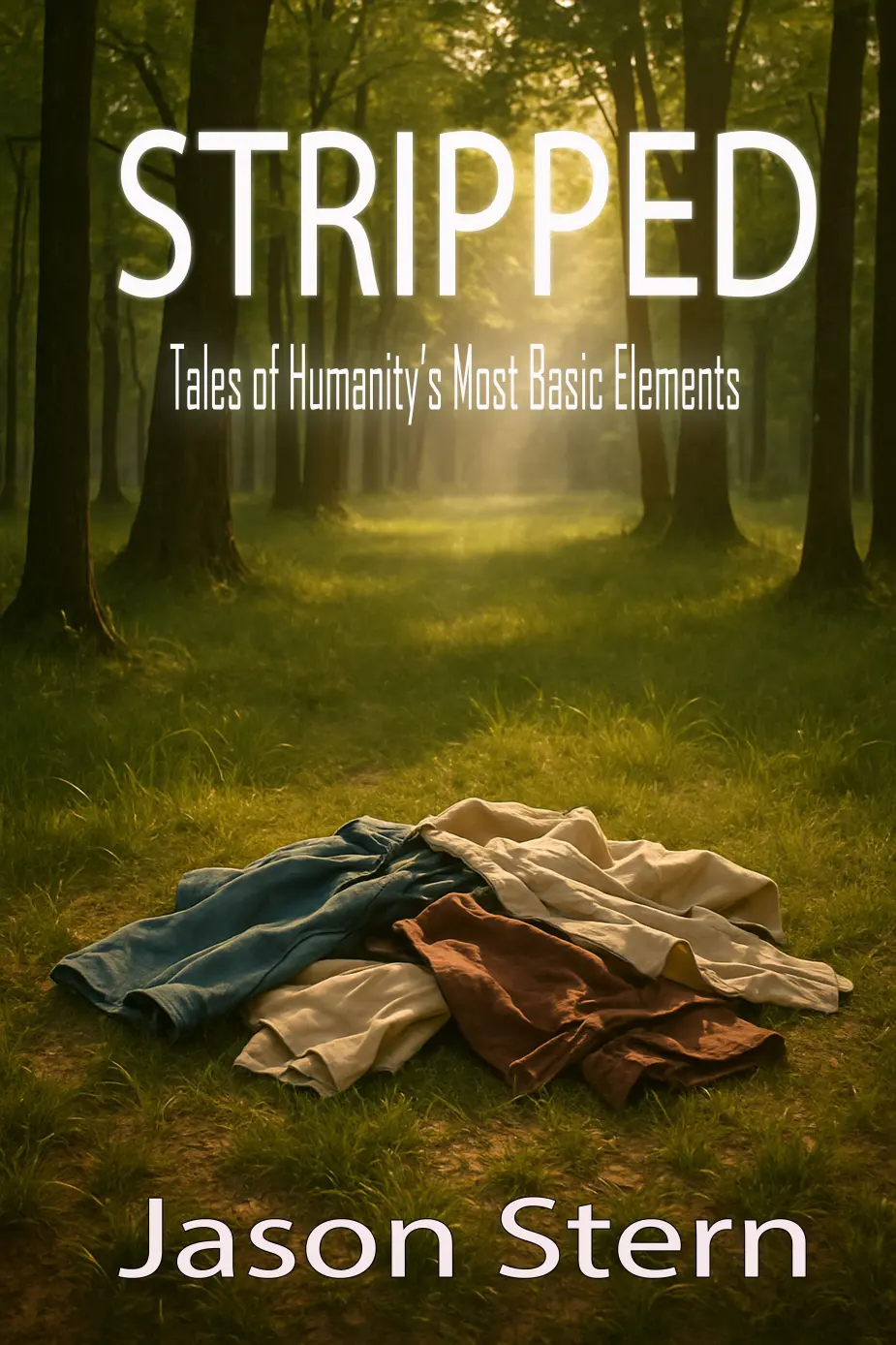
Today’s the day! I’m thrilled to share that my newest book, Stripped: Tales of Humanity’s Most Basic Elements, is officially published and ready for you to read.
What happens when we’re stripped to our most basic human elements? What happens when what we hide behind gets removed?
Find out when you read stories in this collection of genres! The stories pull together poignant emotional journeys that dig deep into what it means to be human when everything else is taken away—our masks, our pretenses, our illusions. In these pages, characters face defining moments that reveal raw honesty, surprising vulnerability, and unexpected freedom.

Christian Naturists face many challenges when facing the world, the church and family and friends. Conversations around the campfire, in hot tubs and over social media inspired these stories. I am so excited to finally share this journey into empathy with you.
Did you enjoy Between Sun and Skin or ReNude Life? This book is for you. You’ll find themes that discuss freedom, identity, spirituality, and the power of being seen.
Stripped is available now on Amazon.com in Kindle and Paperback!
Thank you to my previewers who encouraged, supported, and inspired me along the way. I can’t wait for you to read these stories! And I’d love to hear which one speaks to you most.
Here’s to journeys that bare the soul.
— Jason

We’re so excited to announce the launch of Simple Truths, a new children’s book series from author Jason Stern. This new series of stories is an affordable invitation for young readers to see the world with wonder, joy, and a deep sense of self-acceptance.
Each book in the Simple Truths series uses lighthearted animal or childhood adventures to share a powerful lesson: that God made us just right, exactly as we are. These charming picture books are perfect for young readers or for parents to share as a bedtime story, sparking smiles and laughter with every turn of the page.


Jump into adventures with a cast of unforgettable characters! From Barnaby Bear, who learns that being a “bare bear” is exactly what he wants to be, to Felix Fox, who finds out what the Wise Old Owl thinks of his new duck pants. Each tale celebrates innocence, curiosity, and the simple joy of embracing who you are.
In Zola’s Perfect Swimsuit, Zola the giraffe’s animal friends try to convince her that she needs a swimsuit to go for a swim. But Zola has a different idea, and we think she has the right one!
But the fun isn’t just for animals!

Amelie Goes for a Swim follows eight-year-old Amelie as she asks her mom a very thoughtful question on a hot summer day at the pool: “Why do I have to wear a top?” Find out what happens in this heartwarming story, also available in French!
Every book in the Simple Truths series ends with a thoughtful Scripture verse, planting seeds of faith and wisdom in young hearts. These stories are more than just a fun read; they’re a perfect way to introduce concepts of faith and self-worth during bedtime reading or family devotionals.
At ReNude Life Publishing, we believe in creating books that are both uplifting and accessible. Each book in the Simple Truths series shares a body-positive, Scripturally-founded lesson that little ears and eyes will love. These are stories that are kid-tested, inspired, and will have you laughing and cheering.
Ready to share these powerful lessons with the children in your life? Simple Truths books are available now! You can get your Kindle copies today and start the adventure.

What happens when an ordinary day turns into a test of courage, faith, and the very clothes on your back?
My book, Stripped: Tales of Humanity’s Most Basic Elements, explores these raw questions in a series of six short stories. One of them, “The Naked Shepherd,” begins with Pastor Danny Hart on a simple errand in a busy coastal town. His day, and everyone else’s, is about to take an unforgettable turn. Let’s start the story:
The morning sun glinted off the stained-glass windows of the Open Door Community Church as Pastor Daniel “Danny” Hart locked up the donation box with a satisfied sigh. Spring Break had brought the usual influx of tourists to the coastal town of Seabrook, and with them, a modest bump in the weekly offering.
Danny tucked the deposit bag under his arm, humming an old hymn as he stepped out into the salty breeze. He was in no particular hurry—just another errand in a life full of small, pleasant routines. His flip-flops slapped against the pavement as he made his way toward First National, the only bank in town that still had a human teller.
Inside, the bank was bustling. College kids in neon tank tops and board shorts clustered near the loan desks, giggling over their dwindling vacation funds. A frazzled mother tried to corral two toddlers while filling out a withdrawal slip. A pair of painters in splattered overalls leaned against the far wall, waiting their turn. The air smelled of sunscreen, sweat, and people ready to get on with their lives—standard for a Friday before lunch.
Danny took his place in line behind a group of sorority girls, their tanned legs and designer sunglasses marking them as out-of-towners. One of them glanced back at him, did a quick scan of his cargo shorts and faded “Love Thy Neighbor” T-shirt, and offered a polite smile. He nodded in return, resisting the urge to crack a dad joke.
Then the doors burst open.
Three men in black ski masks stormed in, guns raised.
“EVERYBODY ON THE GROUND! NOW!”
Screams erupted. A teller dropped a stack of deposit slips. One of the college boys instinctively reached for his girlfriend—then froze as a robber jammed a pistol in his face.
Danny dropped to his knees, hands raised, heart pounding. He’d done hospital visits, marriage counseling, even a eulogy for a local fisherman lost at sea. But this? This was new.
The lead robber—tall, broad-shouldered, voice like gravel—kicked the door shut behind him. “No heroes. No alarms. You do what we say, you walk out alive.”
Danny exhaled slowly. Okay. Stay calm. Watch. Wait.
Then came the demand he hadn’t seen coming.
“Clothes off. All of ’em.”
There was stunned silence all around.
“You heard me. Strip. Or we start shooting.”
The gasps were almost comical. The sorority girls clutched at their sundresses. The mother let out a choked sob, pulling her children closer. The painters exchanged a look of disbelief.
Danny, however, felt an odd flicker of recognition.
Oh.
This is about shame.
And just like that, he knew exactly what he had to do.
Without hesitation, he stood up—ignoring the robber’s shouted warning—and pulled his shirt over his head.
Every eye in the bank locked onto him.
The lead robber’s gun wavered. “The hell are you doing?”
Danny smiled. “Following instructions.”
Then he unbuckled his shorts.
In “The Naked Shepherd,” the story only gets more tense from here as the hostages, forced at gunpoint to shed their clothes, begin to find a new kind of power. This is just one of the unique tales you’ll find in Stripped. You’ll also encounter:
Every story is a journey into the raw, unfiltered core of humanity, and this is just the beginning. You can pre-order your copy here. Get ready to uncover what it means to be truly human.