Shifting Shades
In our modern English Bibles, “naked” is just a flat, singular word. It conjures a specific image—usually one of vulnerability or perhaps something that needs to be covered up. But in the original Hebrew, the concept isn’t flat at all. It has depth. It has intensity. There are three shades of nakedness in Genesis 1-3.
Think of it like a grayscale. We often talk about white, gray, and black as “colors,” but they aren’t. They are shades. They represent the intensity of light or the lack thereof. In the Garden of Eden, we see the word “naked” shift through three distinct shades, and if we don’t pay attention to the Hebrew vowels, we miss the entire story of the human soul.
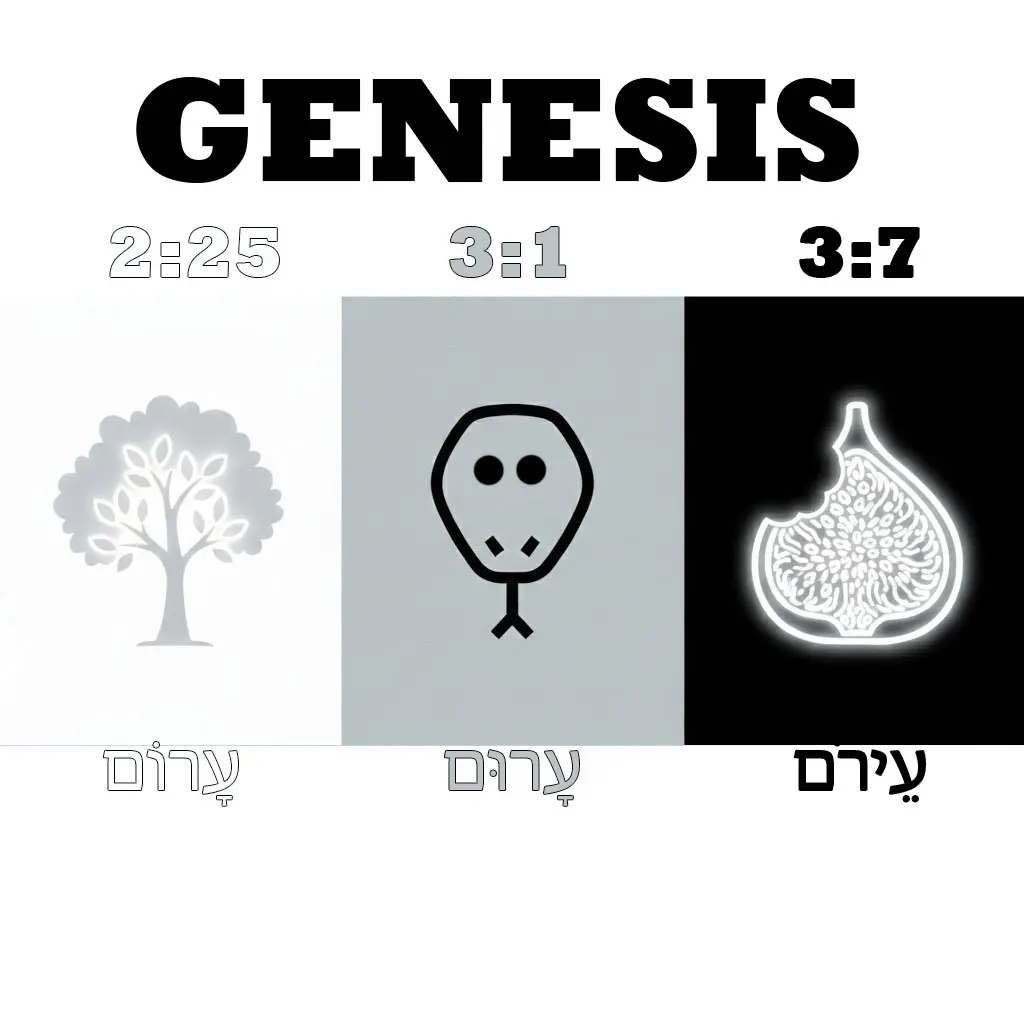
White: Arowm (עָרֹם) – The Shade of Wholeness
The story begins in the light.
“And the man and his wife were both arowm, (naked without lack) and they were not ashamed.”
Genesis 2:25
This is the White of the grayscale. It is the shade of innocence, but more than that, it is the shade of wholeness. To be arowm is to be existing exactly as you were created—unburdened, complete, and lacking nothing. In this state, there is no need for a “protector” because there is no threat. There is no need for “provision” because everything is provided. White is the presence of all light; arowm is the presence of all God’s intent.
Gray: Aruwm (עָרוּם) – The Shade of Strategy
But then, the intensity shifts. Just a few breaths later, we meet the serpent.
“Now the serpent was more aruwm (naked shrewd) than any beast of the field…”
Genesis 3:1
Here is our Gray. Most translators cunningly stop using the word “naked” here and switch to “shrewd,” “prudent,” or “crafty.” But in the Hebrew mind, this is just a different shade of the same root.
Think of gray matter—the brain. This is the nakedness of the mind, a kind of strategic wisdom. It isn’t necessarily “evil” (Proverbs uses this same word to describe the prudent man), but it is a departure from the pure white of simple being. It is the sharp, calculating edge of intelligence. The Serpent wasn’t just “naked” like the humans; he was “nakedly strategic.” He was the gray area between innocence and the dark.
Black: Eyrom (עֵירֹם) – The Shade of Lack
Finally, the light is blocked out. After the fruit is eaten, the humans look at themselves and a new word enters the vocabulary:
“Then the eyes of both of them were opened, and they knew that they were eyrom (naked lack)…”
Genesis 3:7
This is the Black of the scale. This isn’t the “shame-less” nakedness of the beginning. Eyrom is the shade of lack. It is the feeling of being stripped, exposed, and unprotected. It is the heavy realization that you are no longer “whole.”
When Adam hides in the trees and tells God, “I was afraid because I was eyrom,” he is declaring his own bankruptcy. He is saying, “I am in the dark. I have nothing left.”
Who Told You That You Were Lacking?
One of the most profound moments in this linguistic journey happens when God responds to Adam’s fear. God doesn’t say, “Oh, I see you’ve lost your clothes.” He asks a piercing question:
“Who told you that you were eyrom (lacking)?”
God is effectively saying: “I never called you that. I spoke a different shade over you. I called you arowm—whole, complete, and radiant. Where did you get the idea that you were unprotected? That proclamation did not come from Me.”
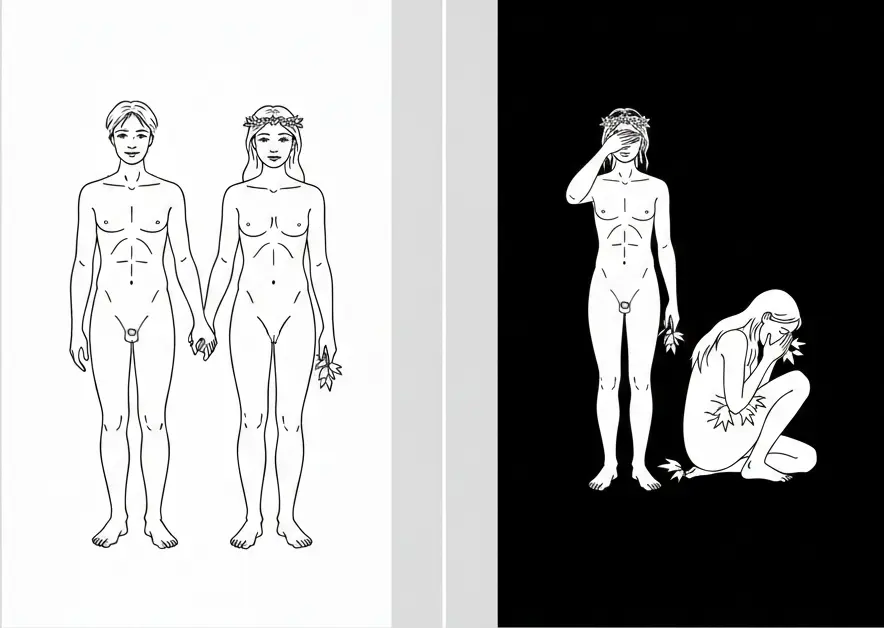
Even in their rebellion, God still saw them through the lens of His original intent. He saw the White, while they could only see the Black.
The Design of Grace
We, modern readers, tend to think of the Fall as a change in our physical bodies, but these Hebrew “shades” suggest it was a change in our perception. We moved from the bright wholeness of arowm into the gray calculations of aruwm, and finally plummeted into the black fear of eyrom.
When we understand that “naked” isn’t always “naked,” we start to see the invitation of the Creator. He isn’t looking for us to “cover up” our lack; He’s provided for us a way to come back into the light where we don’t need the strategy of the serpent or the fear of the fallen. He is calling us back to the White—to be arowm once again, lacking nothing in His presence.
Into the Wilderness
Humanity’s power grab in the Garden broke the seamless fellowship they enjoyed with the Creator. By choosing their own way, they separated themselves from the Source of Light. Consequently, though God never spoke eyrom (lack) over them, that was all humanity could see. They became trapped in the “Black” shade—blind to their original wholeness and fixated on their own vulnerability.
But the story doesn’t leave us in the dark.
The Last Adam
To fix a broken perception, we needed a new Prototype. We needed someone to step back into the grayscale and restore the Light.
“Thus it is written, ‘The first man, Adam, became a living being’; the last Adam became a life-giving spirit. But it is not the spiritual that is first but the physical and then the spiritual. The first man was from the earth, a man of dust; the second man is from heaven. As was the man of dust, so also are those who are of the dust, and as is the man of heaven, so also are those who are of heaven. Just as we have borne the image of the man of dust, we will also bear the image of the man of heaven.”
1 Corinthians 15:45-49 (NRSVUE)
Jesus, the Last Adam, didn’t just come to “cover” our lack; He came to kill the version of us that believed in lack. Through our union with Him, we undergo a total structural shift.
Death, Burial, and Resurrection—Now!
This isn’t a promise for a distant future or a reward in the afterlife. Our restoration to the “White” shade of arowm happens the moment we are joined to the Last Adam.
“What then are we to say? Should we continue in sin in order that grace may abound? By no means! How can we who died to sin go on living in it? Do you not know that all of us who have been baptized into Christ Jesus were baptized into his death? Therefore we have been buried with him by baptism into death, so that, just as Christ was raised from the dead by the glory of the Father, so we too might walk in newness of life. For if we have been united with him in a death like his, we will certainly be united with him in a resurrection like his.”
Romans 6:1-5 (NRSVUE)
Through this death and resurrection, the lens is wiped clean. We no longer have to view ourselves through the “Black” of eyrom—the state of being ashamed, unprotected, or “not enough.”
Friend, are you in Christ? If yes, look at yourself! We can see ourselves and the rest of humanity through the lens of arowm right now, on this earth. We are whole. We are provided for. We are innocent. The “shading” of our lives has been reset by the Man from Heaven. We are arowm in Christ today.
This is Good News! Maybe you should share it with someone?